
Towards Real-Time Models of Living Chemistry
A Different Kind of Twin
The concept of a digital twin is well-established in engineering. A digital twin of a jet engine receives continuous sensor data from its physical counterpart — temperature, pressure, vibration, fuel flow — and maintains a real-time computational model of the engine’s state. That model can be used to predict failure, optimise performance, and test interventions without touching the physical system. The twin is not a static simulation. It is a living model, updated continuously by measurement.
Biochemical digital twins apply the same principle to biological systems. Instead of a turbine, the physical counterpart is an organism, a tissue, a fermentation vessel, or a soil ecosystem. Instead of pressure sensors and accelerometers, the sensing layer measures chemical composition — the concentrations of metabolites, nutrients, proteins, lipids, and other molecular constituents that define the biochemical state of the system at any given moment.
The ambition is considerable. A sufficiently accurate biochemical digital twin could predict how a biological system will respond to an intervention before the intervention is made — adjusting a fermentation substrate, modifying a patient’s diet, applying a fertiliser blend, or reformulating a food product — and do so in real time, from continuous non-destructive measurement.
Near-infrared spectroscopy is one of the few analytical technologies capable of providing the measurement layer this vision requires.
Why Measurement is the Hard Problem
Building a digital twin of a mechanical system is tractable in part because the relevant state variables are relatively few and physically well-defined. Pressure, temperature, and flow rate can be measured continuously, non-destructively, and with high precision using mature sensor technology.
Biological systems are compositionally complex, dynamically changing, and sensitive to measurement interference in ways that mechanical systems are not. Drawing a blood sample to measure glucose disrupts the system being measured. Extracting a soil core for laboratory analysis destroys the spatial structure that determines how nutrients move through the matrix. Homogenising a food sample to run a wet chemistry assay eliminates the heterogeneity that may be analytically significant.
Non-destructive, continuous, in-situ measurement is not merely convenient for biochemical digital twins — it is structurally necessary. A twin that can only be updated by destructive sampling is not a twin in any meaningful sense. It is a periodic snapshot with a model interpolated between observations.
Near-infrared spectroscopy measures the chemical fingerprint of a sample by analysing how it absorbs light across the 900–1700 nm wavelength range — without reagents, without contact in many configurations, and without altering the sample in any way. This makes it uniquely suited to providing the continuous, non-destructive measurement stream that a biochemical digital twin requires.
From Spectra to State
The gap between a raw NIR spectrum and a biochemical state estimate is bridged by chemometric modelling — the calibrated relationship between spectral features and chemical concentrations. For a biochemical digital twin, this relationship must be not only accurate but dynamic: the model must account for the fact that biological systems change over time, that the same spectrum may correspond to different biochemical states at different points in a process, and that measurement conditions themselves may vary.
This is where chemistry-informed machine learning becomes structurally important. A purely data-driven spectral model maps inputs to outputs without encoding any knowledge of the underlying biology. A chemistry-informed model incorporates known biochemical relationships — mass balances, reaction stoichiometries, kinetic constraints — as structural properties of the learning objective. The result is a model that not only predicts current composition but does so in a way that is consistent with the biochemical dynamics of the system it is monitoring.
The twin, in other words, is not just a measurement system. It is a model of how the system behaves — and that model is continuously updated and constrained by real spectral data.
Concrete Frontiers
The applications of biochemical digital twins span several domains at different stages of development.
Personalised nutrition and metabolic monitoring. The metabolic response to diet is highly individual — two people consuming identical meals may show substantially different postprandial glucose, lipid, and amino acid profiles. A biochemical digital twin of a human metabolic system, updated continuously by non-invasive NIR measurement of blood composition proxies through skin or interstitial fluid, could in principle support truly personalised dietary recommendations and early detection of metabolic dysregulation — without blood draws, without laboratory delays, and without the averaging effects that obscure individual variation in population-level studies.
Precision fermentation. Industrial fermentation processes — for food ingredients, pharmaceutical intermediates, and biofuels — are biochemically complex and time-sensitive. Small deviations in substrate concentration, pH, or dissolved oxygen can cascade into significant yield losses or product quality failures. A biochemical digital twin of a fermentation vessel, updated in real time by NIR measurement of the process stream, could predict these deviations before they manifest as observable process failures — enabling proactive intervention rather than reactive correction.
Soil as a living system. Agricultural soil is not a passive growth medium. It is a biochemically active ecosystem whose composition — organic matter, moisture, nitrogen, phosphorus, microbial biomass — determines crop yield, carbon sequestration capacity, and long-term fertility. NIR-based soil monitoring at sufficient spatial and temporal resolution could provide the measurement layer for a soil digital twin capable of guiding precision fertilisation, irrigation scheduling, and regenerative agriculture practices with a level of specificity that population-average agronomic recommendations cannot achieve.
The Distance Still to Travel
Biochemical digital twins are not yet a deployed technology in most of these domains. Several hard problems remain.
Biological variability is substantially greater than mechanical variability — the same organism in different physiological states may produce spectra that challenge even well-calibrated models. The reference data required to build accurate chemometric models for complex biological matrices is expensive to acquire and difficult to standardise. And the computational architectures required to maintain a real-time dynamic model of a biochemically complex system are still maturing.
What has changed is the convergence of enabling technologies. Non-destructive sensing capable of continuous biological measurement now exists at portable scale. Machine learning architectures that can encode biochemical prior knowledge are an active and productive research frontier. Cloud computing infrastructure capable of maintaining and updating dynamic models in real time is commercially available. And the appetite — in personalised medicine, in precision agriculture, in industrial biotechnology — for the kind of continuous, system-level insight that a biochemical digital twin could provide is substantial and growing.
The twin is not yet real. But the measurement layer that will make it possible is operational today.
Ready to test your own samples?
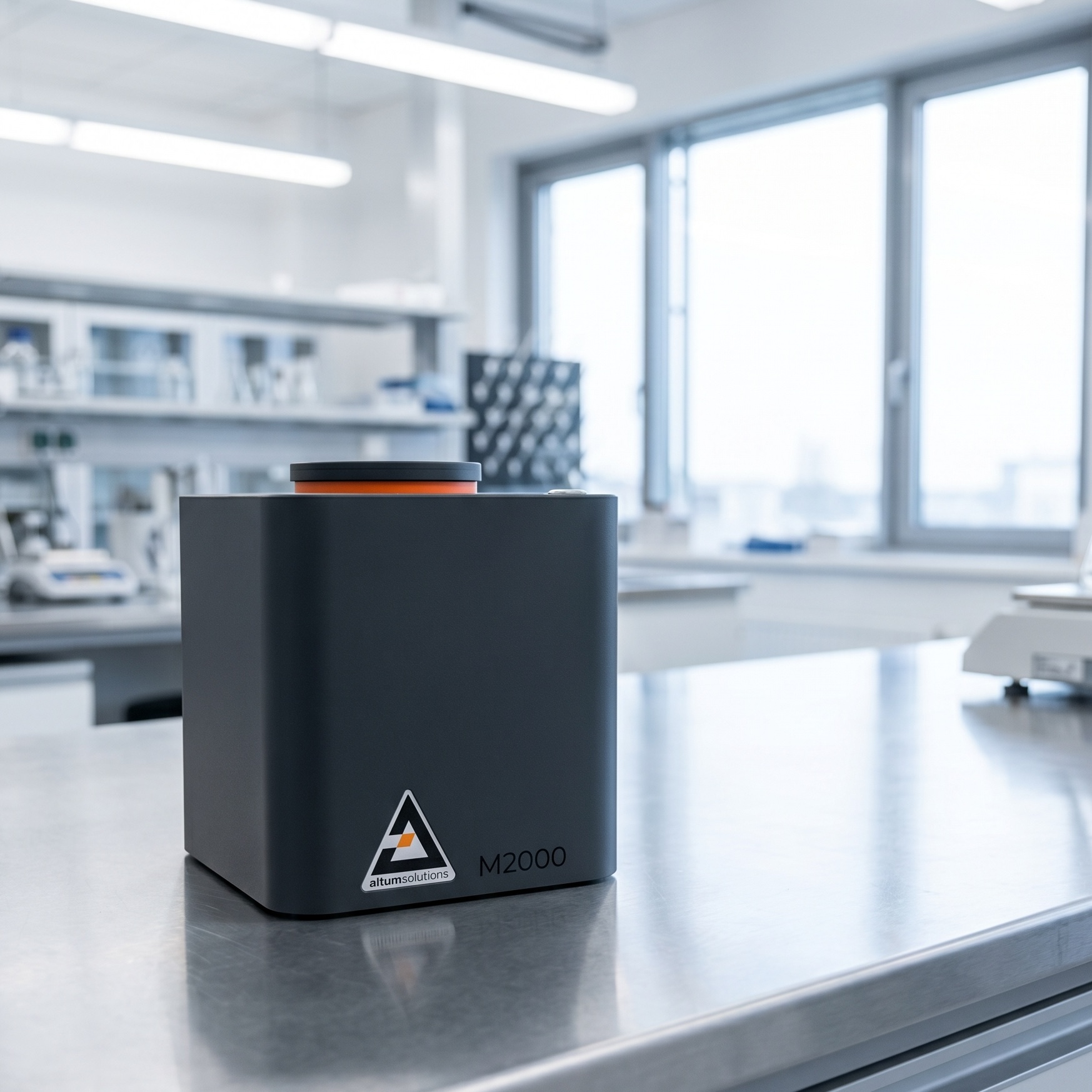
See what the M2000 does with your material — before any commitment.