
One Filter, No Moving Parts
Most portable near-infrared instruments on the market are built on a single component: the linear variable filter, or LVF. A thin film etched with a controlled thickness gradient disperses light the way a diffraction grating does, but without any moving part, no slit, and none of the optical path length that a grating monochromator needs.
The device that made this practical at production scale is documented in a 2012 SPIE paper — Miniature Near-Infrared (NIR) Spectrometer Engine for Handheld Applications — written by the JDSU Santa Rosa team (O’Brien, Hulse, Friedrich, van Milligen, von Gunten) with Frank Pfeifer and Prof. Dr. Heinz Siesler of the University of Duisburg-Essen. Notably, the same two academic co-authors are also on the 2023 Chemosensors review examined earlier in this series, which makes the pair a coherent line of evidence: the engine, then the state of the art built on it.
It is not an Altum paper, and we are not claiming it as one. It matters to us because it describes the architecture that every portable instrument has to contend with, and because it states, early and clearly, the trade-off that most product literature quietly skips.
The Argument for Compactness
The paper’s core case is that an LVF-based engine can hold a full useful NIR range in a footprint small enough to sit behind a lens, against a sample, in a device a person can carry into a field, a cellar, or a plant floor. Three properties fall out of the physics:
- No moving parts in the optical train. Nothing to drive, nothing to wear, nothing to recalibrate after ten thousand scans.
- A short optical path. The light travels centimetres, not centimetres-plus-mechanism, which is what lets the whole engine live next to a detector rather than across a chassis from it.
- Detector choice does the real work. In this architecture, the detector — typically an InGaAs device, well suited to the short-wave NIR regions — sets the noise floor as much as anything upstream does.
The Line Where Miniaturisation Costs
The paper’s most useful sentence to a buyer is also its most cautious. Miniaturisation is legitimate only while it does not materially degrade the performance the measurement needs. In the paper’s own validation, the engine tracked a soil property across a 0–12% range against reference — adequate for the class of task, not a laboratory substitute, and stated as such.
That sentence is the whole purchase question, in one line. A portable that is small because it gave up nothing measurable is an engineering achievement. A portable that is small because it gave up the spectral region, the detector quality, or the scan speed — and never says so — is a different product, and a bad one for the task it is being asked to do.
The paper’s own field validation is honest about the limits: it quantified oil contamination in soil across a 0–12 % (w/w) range against reference — a working in-field result for one analytical problem, not a substitute for the laboratory, and presented as exactly that.
What to Ask Before You Buy
The paper’s framing translates directly into three questions to put to any portable vendor, Altum included:
- Which band, and why that one? Not “full NIR” — the specific wavelength range, and the detector that serves it.
- What does the size cost? If the instrument is small, which parameter — signal-to-noise, scan speed, wavelength range, or thermal stability — paid for it?
- What is the stable reading, not just the fast one? Integration time and warm-up behaviour matter more than any single headline number.
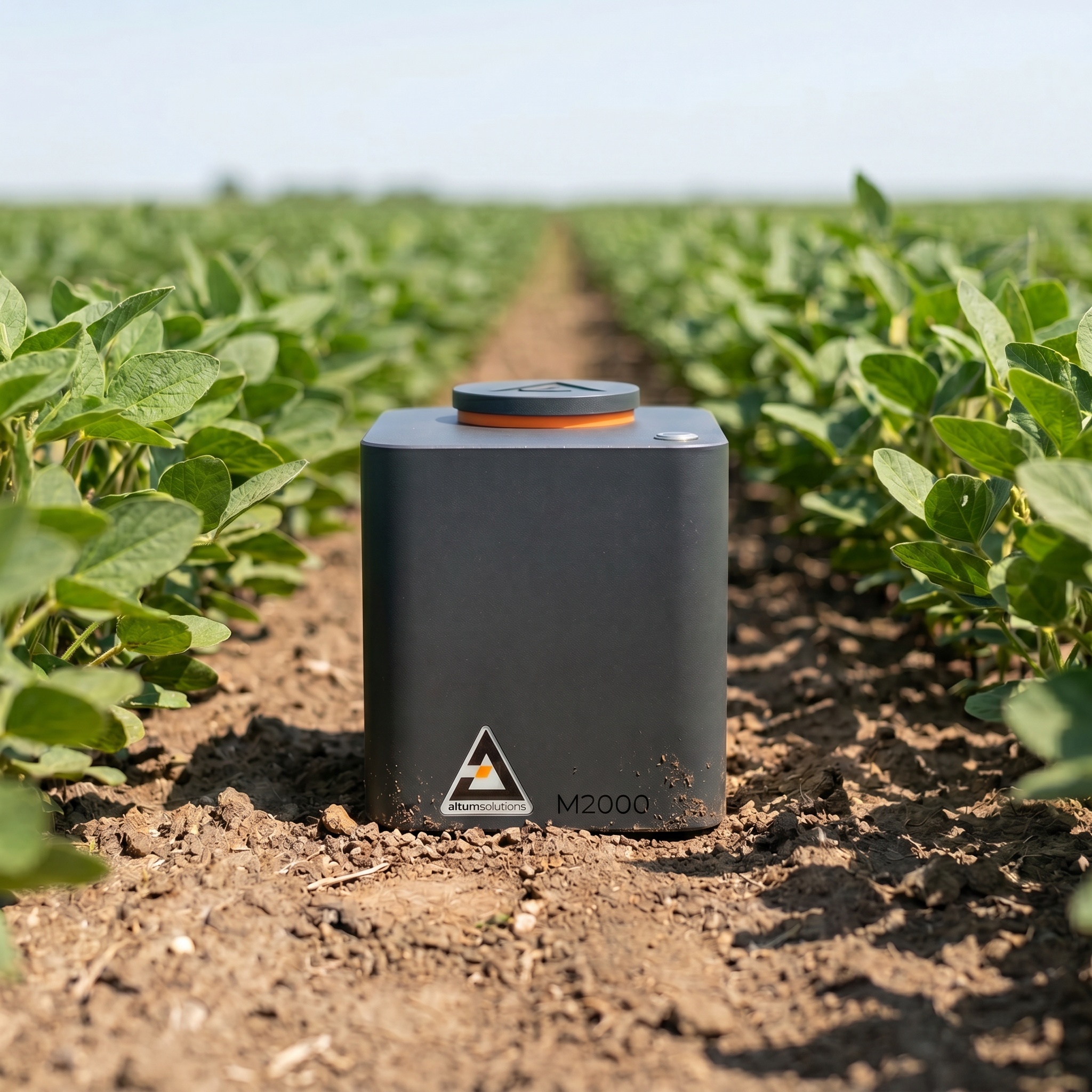
We answer all three of these on the M2000 and M2000T pages, and we will keep doing so, because a customer who cannot get a straight answer to them should be able to see why.
Full reference: O’Brien, N.A.; Hulse, C.A.; Friedrich, D.M.; van Milligen, F.J.; von Gunten, M.K.; Pfeifer, F.; Siesler, H.W. “Miniature Near-Infrared (NIR) Spectrometer Engine for Handheld Applications.” Proc. SPIE 8374, 837404 (2012). https://doi.org/10.1117/12.917983 (© SPIE — cited, not reproduced).
Reading order: Handheld NIR, Peer-Reviewed — the 2023 review this paper’s architecture was tested inside.
Ready to test your own samples?
See what the M2000 does with your material — before any commitment.